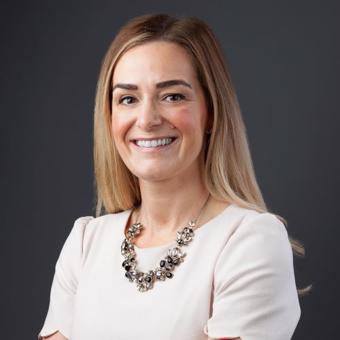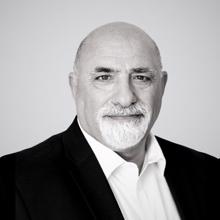
Louis Charalambous
Partner, Media and Communications Disputes at Simons Muirhead Burton
Louis Charalambous talks to The Brief about his recently published book, Better Call Louis, which explores a career representing celebrities, facing down gangland bosses and pioneering new tactics to achieve justice for victims of industrial disease.
The media lawyer Louis Charalambous, one of just three “Senior Statespeople” ranked by Chambers UK for Defamation and Reputation Management, has worked on some of the highest profile defamation cases of last two decades.
His recently published book, Better Call Louis, lifts the lid on these and provides a fascinating glimpse into a career that has taken in many of the UK’s biggest libel causes célèbres.
Equally gripping, though, are the insights into his early career, with matters ranging from criminal law to the use of groundbreaking tactics to gain justice for victims of asbestos, as well as representing bereaved families at inquests, and the defence of journalists and media organisations against criminal allegations and regulatory enforcement.
Political activism and legal awakening
The child of Greek Cypriot immigrants, Charalambous grew up in working class Hackney, East London. Politically aware from an early age, he went on to become involved in student journalism and anti-fascist activism while reading Peace Studies at Bradford University in the mid-1970s.
After graduation he worked briefly with children in care before taking a Master’s degree in Political Sociology at the University of Leeds.
Around this time he became preoccupied with the case of the so-called “Bradford 12” – a group of young Asian men arrested for making and storing petrol bombs in case their neighbourhood was attacked by the National Front.
Charalambous became an organiser of a campaign in support of the “12”, which coalesced around the slogan “Self-defence is no offence.” Sitting at the heart of the campaign, he witnessed at close quarters the work of the 12’s legal team, which included the young barristers Helena Kennedy and Geoffrey Robertson.
Amber Heard stands out as somebody who was not only thoughtful but incredibly pleasant and good to work with.
He realised, “there and then” where his vocation lay and set off on the road to qualifying as a lawyer. After law school he was articled to Pickerings, a personal injury firm in Oldham, and over the years that followed worked on a number of groundbreaking cases involving asbestos exposure.
Then, in the mid-1990s, he returned to the capital and joined a small headline-grabbing practice called Stephens Innocent. Here he stared working for members of the National Union of Journalists who had become “embroiled with” the police.
Criminal to libel
“I didn't move to Stephens Innocent with a view to becoming a libel lawyer. But media definitely interested me,” he tells The Brief.
“Initially I purely did criminal work for media workers but I have always had a fascination with reputation as an area of law – how it’s conducted and the balance between privacy rights and freedom of expression.
“The initial media work I did was trying to get journalists off the hook or trying to get organisations out of the messes they got into with regulators or the police. But then I realised that, especially with libel, nearly all of the cases involve some kind of misconduct, normally with a criminal aspect, so it wasn’t that unfamiliar really.”
True grit
Although many of Charalambous’s cases have involved celebrity, others couldn’t be further removed from the glitzy world of showbiz. Defending The Sunday Times in a libel suit brought by the alleged gangland boss David Hunt in 2013 was one of these – involving, to deploy a technical term, balls of steel on the part the legal team, the defendants and witnesses.
Described in a chapter entitled “The Long Fella rides in”, this was a case in which Charalambous’s background in criminal law was “of huge help”, he tells The Brief.
“The case involved wading through thousands of pages of documents of a kind that would have been unfamiliar territory to a lot of libel solicitors. It also involved dealing with people in and around the criminal justice system.
“These included suspects, ex-cons, and ex police officers – some of whom had been disgraced. It was all very familiar territory for me.”
Charalambous is nonchalant while describing this but the details, which include the key witness’s security team having to be replaced at short notice after having the frighteners put on them, sound frankly terrifying.
Not their finest hour
Before moving over to defendant work, Charalambous successfully represented two individuals who had received notorious “monsterings” from the press: Robert Murat, who was subjected to a relentless campaign by the press – based largely on a (possibly wilful) misunderstanding of the Portuguese legal system – in the wake of the disappearance in 2007 of Madeleine McCann, and Christopher Jefferies, the Bristol schoolteacher and landlord wrongly accused of the murder in 2010 of his tenant, the young landscape architect Joanna Yeates.
A cost cap should be introduced so more cases can actually see the light of day, because very few people can afford libel litigation now.
In these cases, fought by Charalambous on a no-win, no-fee basis, very substantial damages were sought, and secured, not just by way of compensation but also vindication: monetary amounts (although not made public in the case of Jefferies), supplemented by apologies in open court, that should leave the world in no doubt as to who the true villains of the piece were.
As the newspapers in question’s own lead lawyer, Keith Mathieson of RPC, was to remark to Charalambous in both cases: “Not the press’s finest hour.”
Sense of justice
Although financial compensation is an indicator of the seriousness of the wrong experienced by a claimant, in many of Charalambous’s cases it seems at most to have been at most an incidental factor for clients.
“What is more important has been the sense of justice,” he explains to The Brief. “Some of these cases feel very personal.”
None more so, perhaps, than The Sun’s defence of a libel suit brought by the actor Johnny Depp in 2018 after the paper described him as a “wife-beater”. While financial considerations would have been paramount for Charalambous’s client (The Sun), money played no part for the defendant’s key witness, Depp’s former wife Amber Heard.
“Amber Heard stands out as somebody who was not only thoughtful but incredibly pleasant and good to work with. My experience until then of celebrities had always been relatively mixed, in terms of their expectations, demands, and their wish not to do any work on their cases, but she was totally different.
“She worked really hard and was generous in terms of her time. The only way we could have won that case was with her.”
The Sun won its case against Depp but Heard was then to face a very different result in a 2022 defamation trial in the US. Brought directly against her by Depp, Charalambous says she was hopelessly outgunned financially.
A factor in her losing that case was, he says, the fact that libel cases are still decided by juries in the US, whereas they have, since 2013, been determined by judges in the UK. He says this mitigates the effects of a mismatch of resources between the parties.
“In London I was able to tell my opponents very early on that they could do all the grandstanding they wanted but it was going to have zero impact on a High Court judge from the Queen’s Bench division,” he explains.
“Luckily we were able to get a level playing field by having a team that was just as strong as his, although it was half the size. But, as I say in the book, the resources in the US case were so uneven, and with the jury system and the influence of online campaigning, I wasn't at all surprised the decision in the US went the other way, especially when some of our evidence was excluded from the trial over there by the judge.”
Cost control
That is not to say he believes all is well in the British justice system as it pertains to libel – far from it.
In the final chapter of Better Call Louis, Charalambous makes a closing plea for costs to be brought under control. Speaking to The Brief, he expands on this: “The court system, the judges and the system generally have allowed costs to explode exponentially.
“Although there are mechanisms in place to bring costs down to a reasonable level these are rarely exercised. I think a cost cap should be introduced so more cases can actually see the light of day, because very few people can afford libel litigation now.”
I’m glad I’m not the author of letters which threaten Hell and damnation for journalists who are investigating someone’s possible wrongdoing.
Inflated costs affect defendants as well as claimants, he continues: “It distorts outcomes because lots of cases that should have determinations are settled.
“Quite often people are forced into settlements by the threat of bankruptcy, or by the insistence of their insurers.”
Justice for asbestos victims
When reflecting on the work of which he is proudest, Charalambous points not only to his more recent complex defamation matters but also to the earlier cases with Pickerings in which he was able to secure justice for victims of asbestos poisoning.
One of these was brought on behalf of Arthur Margereson, who grew up close to an asbestos factory in Leeds in the 1930s and went on to develop mesothelioma in 1990. Although the company responsible had ceased trading long ago, and held no records, Charalambous was able to pierce the “corporate veil” and seek documents held by its parent company, which was still active, which demonstrated it had known from an early stage about the risks posed by asbestos dust.
Sadly, Margereson died before judgment was handed down but the court ruled decisively in favour of his widow, who had become the plaintiff following her husband’s death.
Another asbestos-related case, which does not feature in the book, involved, “a lovely man called David Kent”.
We knew that a change in the law was coming that would allow a company to be restored to the register in order to sue it.
Kent had worked for his father’s company as a young man and, unwittingly, been exposed to asbestos dust. By his early fifties, when he instructed Charalambous, he was dying of mesothelioma.
Charalambous explains, “His father’s company had been wound up long ago but we knew that a change in the law was coming that would allow a company to be restored to the register in order to sue it. This was only going to be of any use if you could find the employer’s liability insurance.
“Because David had taken the company over he knew who the employer’s liability insurers were for the period of his exposure, so we were able to restore a dead company to sue the insurers.”
Rather than settling, the insurers fought the case all the way to see whether this new method of securing compensation would work. The precedent it set was not the one they would have wanted, with judgment made in favour of Kent just before he died, enabling his widow to receive compensation.
“I still keep that judgment,” Charalambous says.
The right side
Reflecting on his career, working both for defendants and claimants, he says, “I am very much against the idea that all claimants are good and all defendants are bad, or vice-versa. There are good and bad on both sides.
“What I have tried to do, not always successfully, is to be on the side I’d rather be on, even if that means not succeeding. In a way that is easier as a claimant solicitor but you do sometimes get people who want to bring terrible cases.
“We all know about SLAPPs [strategic lawsuits against public participation], and the clampdown on them, and I’m glad I’m not the author of letters which threaten Hell and damnation for journalists who are investigating someone’s possible wrongdoing. I have always been close to journalists and built my practice on defending their rights which are under constant attack from many quarters.
“On the other side, if you come up against a case like Chris Jefferies or Robert Murat, where someone is being monstered completely wrongly, because of prejudice or police tip-offs or whatever, then you know which side’s the obvious right one.”
Want to hear more?
Readers who would like to hear from Charalambous in more depth might wish to catch his appearance at the Oxford Literary Festival where, on 21 March 2026, he will be interviewed about the cases described in Better Call Louis by the freelance journalist and broadcaster Nick Wallis, who is best known as the author of The Great Post Office Scandal and The Great Post Office Cover-Up.