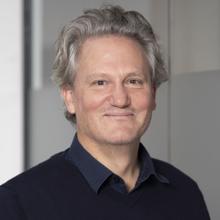
Luke Minford
Chief Executive Officer at Rouse
The chief executive of Rouse shares his thoughts with The Brief about what makes a great IP practitioner, the role of AI in innovation, his firm’s plans for the future and how a highly mobile childhood equipped him for the challenges of leading an international intellectual property business.
Luke Minford is CEO of the specialist intellectual property services group Rouse. Based in London, he leads an organisation that employs more than 1000 people across 43 offices in 19 different jurisdictions.
The firm was founded in the UK in 1990 by Peter Rouse. It quickly expanded into China and Southeast Asia during the 1990s, based on its founder’s previous experience of working in Singapore and the wider Asian market during the 1980s.
Minford, meanwhile, was living in Beijing in the 1990s, where he had been studying the Chinese language after qualifying as a lawyer in New Zealand, and was looking to apply his skills in the Chinese market.
Early life
Minford is the son of the eminent scholar of Chinese literature John Minford, and nephew of the high-profile economist Patrick Minford. His childhood saw him move from the UK to Australia, then to Tianjin, China.
This was in 1980 and, although the country was in the early stages of opening up after the Cultural Revolution, it remained relatively uncharted territory for expatriates – and their children.
Reflecting on this period, Minford says, “As a nine-year-old, I got thrown into a Chinese school where nobody spoke English, and I just had to learn how to communicate.
“My early life made me comfortable with complexity and change. It made me willing to accept that sometimes you just don’t have the answers and you have to figure things out.
“It taught me that processes require time. You can’t always predict outcomes but you’ve got to keep at it.”
As a nine-year-old, I got thrown into a Chinese school where nobody spoke English, and I just had to learn how to communicate.
Three years later, Minford briefly returned to England to live with his grandmother, before rejoining his father in Hong Kong and finally moving to New Zealand, where he completed his schooling and went on to study law at the University of Otago.
Having qualified as a lawyer, he moved to Beijing to study the Chinese language, and a chance encounter with a colleague of Peter Rouse while on a trip to London led him to join the firm where he has spent his entire career.
Career ladder
Minford spent four years as a senior associate at Rouse’s Shanghai office in the late 1990s, focusing on anti-counterfeiting, trademark enforcement, commercial and advisory services. This was followed by stints in Hong Kong, and as office team leader in Beijing, before becoming country manager for China in 2005.
In 2010 Minford, who by this point had a wife and two daughters, relocated to London as UK country manager. “I was a long-haired Kiwi lawyer who had only ever worked in China, arriving in London and figuring out how to lead a UK IP practice,” he says.
He moved to the UK with the primary goal of trying to align it with the global business, something he describes as, “A baptism of fire.”
I was a long-haired Kiwi lawyer who had only ever worked in China, arriving in London and figuring out how to lead a UK IP practice.
At the time, he says, “I really struggled with the challenge because our UK business was so different from the rest of Rouse in terms of the clients, nature of services and culture. Looking back, I’m now truly grateful for what it taught me about change and leadership.”
And three years later, in 2013, he was offered the role of CEO, a position he has held ever since.
He says his depth of understanding and experience with both Western and Asian systems and cultures were a key factor in his appointment. “Not many people have that duality,” he explains.
Scope of services
Minford is the chief executive rather than the managing director of Rouse. “From the very beginning, Peter Rouse set the firm up as a shareholding company with a chief executive,” he explains.
“Rouse is now made up of a group of companies, many of which are not law firms, delivering services ranging from consulting to trademarks and other advice. And then some of our services are delivered through independent regulated law firms that aren’t owned or controlled by Rouse.
“So, Rouse is a network of companies that are ultimately bound by the same set of principles and the same governing mandate to deliver truly valuable IP services to our clients. Despite this underlying structure, our mission is to ensure the client feels no separation, just one seamless and integrated service experience.”
The firm’s core service, Minford says, is the filing, registration and management of intellectual property rights – predominantly those relating to technology, pertaining to brands and designs, as well as IP rights relating to content.
We are a broader church and have professionals within the Rouse organisation who are not lawyers but who work very much side-by-side with our lawyers.
“In most cases this work is carried out by specialist attorneys, because these are complex legal rights,” Minford explains. “Our core practice is the delivery of services relating to the effective management and prosecution of these intellectual property rights in each jurisdiction.”
However, he continues, Rouse goes beyond this strictly legal work and provides clients with support in adjacent areas “that don’t necessarily require lawyers”, including business strategy and commercial licensing of IP.
“So we are a broader church and have professionals within the Rouse organisation who are not lawyers but who work very much side-by-side with our lawyers,” Minford says.
Global capability
Minford says Rouse is one of a number of firms currently seeking to build “global capability” across all the key services that fall under the intellectual property umbrella.
Expanding on this, he says, “We're looking to invest in the technology that's going to enable all of those services and capabilities to connect, operate and integrate globally, and that's a huge task. It requires us to move into new markets and to be able to offer quality services in markets that we're not currently in.
“It also requires us to build capabilities where we're not currently as strong as we need to be. Over the last three or four years, we've been doing this through mergers and acquisitions, as speed to scale is essential given the challenges on the horizon.
“We're not yet halfway there in terms of where we want to get to, but we're certainly a lot further along that path than we were a few years ago.”
AI, innovation and regulation
AI is, of course, a major talking point in all areas of the law – arguably none more so than intellectual property. The debate surrounding copyright and the training of large language models, in particular, is high on the agenda of the mainstream media (probably in no small part due to their own position as copyright owners).
Minford, however, points to AI’s role in creating, rather than processing, intellectual property, and the unexplored legal territory this opens up.
He says, “A really important dimension of AI is how clients are using it to improve and accelerate their innovation processes. We’re just starting to see R&D departments and innovation teams discover how much more effective and productive they can be, and how much more, and higher-quality, IP can be created once companies start introducing AI into their innovation processes.
“So, one dimension is that there is going to be more quality IP in the system, and that is going to mean more complexity, both in terms of scale in the commercialisation process, and more challenging disputes.”
Once one of the major economies, whether that be Europe or China, comes out with a framework for how AI is going to be regulated then that will at least provide some kind of benchmark.
Governments are, he says, just beginning to grapple with how to adapt their laws and regulations. “How can companies own the products of innovation?” he asks.
“Is it the product of AI or of an individual inventor? It is still way too early to understand how Western governments, in particular, are going to respond to this.
“We have no real sense of where we’re headed with this but I think that once one of the major economies, whether that be Europe or China, comes out with a framework for how AI is going to be regulated then that will at least provide some kind of benchmark which we can see whether others follow or diverge from.”
Thirdly, he says we need to consider how AI will impact on the manner and efficiency with which IP is deployed: “Will we need as many lawyers, will we need as many systems as we currently use to manage IP around the world, when AI is going to become so much more effective in pulling together and managing data, and informing the users of IP systems?
“It’s going to impact us far more than we think, but it will depend on which lens you look at it through. I’m personally really excited and positive about the benefits for innovation but it’s a challenge in terms of how governments respond from a legal and regulatory perspective.”
More than the law
Against this backdrop, what advice would Minford have for aspiring lawyers considering embarking on a career in intellectual property?
IP now lies at the core of how businesses are competing and innovating, so just being a lawyer is not enough.
He says, “My controversial view is that if your passion is for being a lawyer, and rooting your practice in a really deep knowledge of the domestic law in your own jurisdiction, then there are probably other fields of practice to which you would be better suited.
“If, though, your passion is for innovation and intellectual property then having legal skills is going to be really valuable but the role involves far more than that. The skill set you will evolve includes understanding brands, content and business.
“IP now lies at the core of how businesses are competing and innovating, so just being a lawyer is not enough. Of course, the law is a key element of intellectual property practice but it is also essential that you have a broader view of where IP value sits in the client’s business and its role in the wider economy.”
Visit
Connect with Luke Minford via LinkedIn